When I Grow Up

Return to Real Life

I have been in this place before. Life has been slower, heavier. I have been in a fog. Things necessary to continue living have gone on; a lot has been left undone. The sadness is still here, and I know it will stay for a while. I also know that the sharp pain of loss will come back at random moments. Seemingly innocuous things will trigger it, like anything with peanut butter.

Finding my new normal I know will take time. When a being is part of your everyday life, the absence is very obvious. Trying to comfort others while in pain yourself is also difficult. Shared grief is a little easier in one sense, because you know that others understand since they too are hurting, but it is easy to repress your own feelings when you are trying to help soothe others’ pain, which can sometimes make the process longer. Even Maggie, our other dog, is out of sorts.

I put the collar away that day. The bowl went into the dishwasher where I found it later. Fortunately, over time, Maggie has commandeered most of the toys, so there is little else that was considered exclusively Zeke’s. My everyday triggers have been more routine behaviors: the morning ritual of standing guard so each dog would eat only his or her own food, the confusion and tangle of two leashes and 10 legs (counting mine). Things are simpler now, and much quieter. The puddles at the water bowl are gone; my feet stay dry. We need to start regular walks again, get back into some sort of routine, though I am not yet ready for the inevitable question on the street. I want to stay inside and hide. I need to get back out there again.

Life still happens. There are still chores to complete, holidays barreling at us, preparations to be made. As I have said to some family members, yes, this is sad, but it is an expected part of life. We don’t get to spend forever with all of our loved ones, especially those of the canine variety. The only way to avoid this pain is to not have them in our lives to begin with, a choice I am not willing to make.

Each day is a little easier. The fog lifts a little. The undone chores are being tackled. Future plans are being made. Together, we all will get through it. As much as it hurts, it was definitely worth it.


Time to Say Goodbye

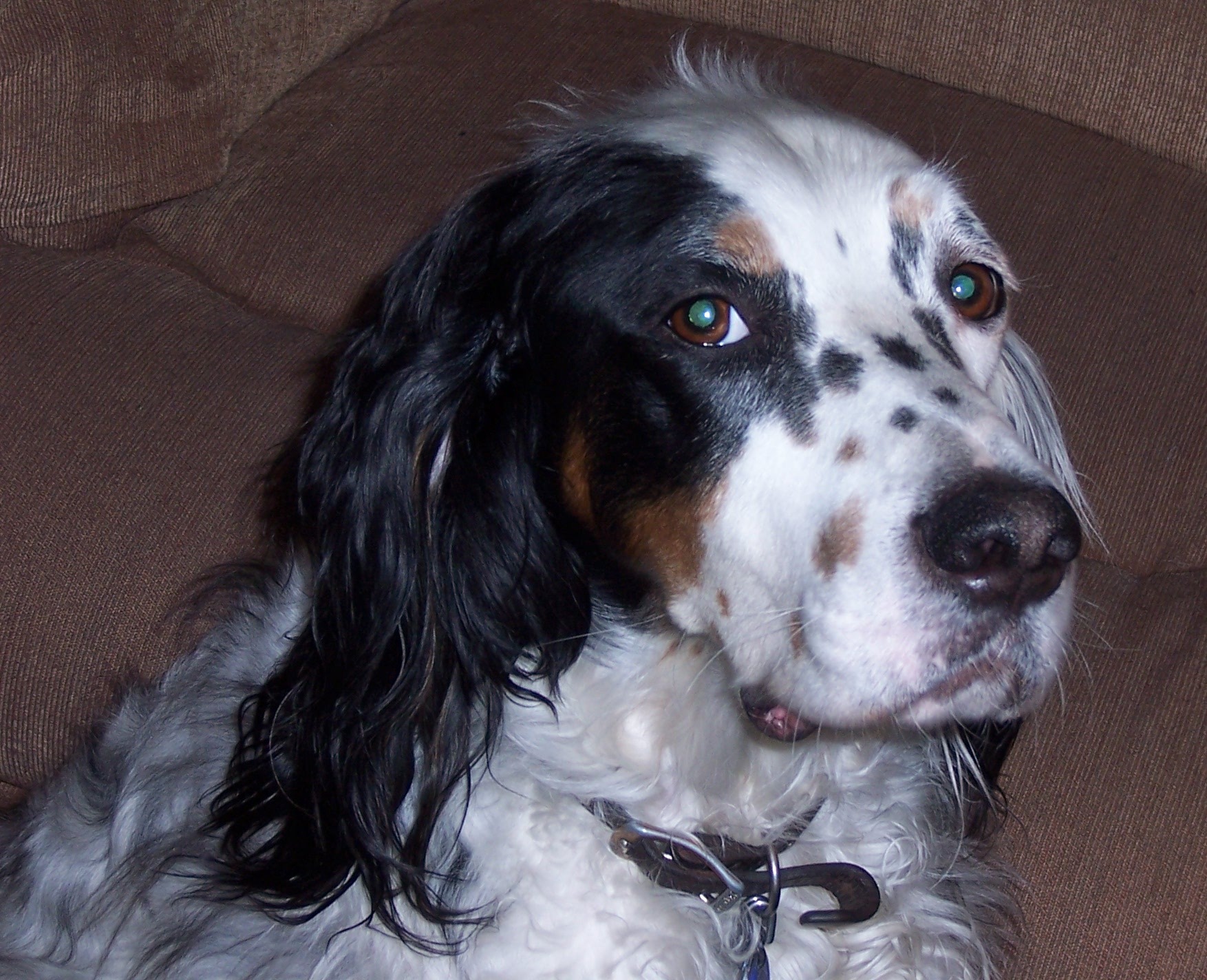
It was ten and a half years ago that we rescued each other. I had been in a dark place for months, since the death of our prior dog, who had helped me teach my four children to be kind and compassionate, while being more patient than any living being ever should. My youngest was in kindergarten, so the emptiness in the house was amplified. He was skinny, snotty and quiet, with some of the kindest, gentlest big brown eyes I had ever seen.

The day we met, I noticed that he had been freshly groomed and asked if his coat was naturally short on his back, or if it had been trimmed. The woman holding the leash lied. She was obviously desperate for him to find a home. She told us of her own English Setter, Jack, and how she would take this one home too, if she could. I think we both knew that that day was likely his last chance. He was seriously underweight and had an upper respiratory infection that could not be hidden by a bath and haircut. He leaned into my leg and looked up at me. I was hooked.

At home, he was afraid of all sorts of things. He didn’t know where to go, and when I took the broom out to sweep the floor, he ran, looking for a place to hide. He had clearly had difficulties in his life, but he was gentle, trusting and affectionate. We took a family vote to name him and settled on Zeke. After two weeks, his upper respiratory infection was clearing up and he was starting to put on weight. Since there was a clause in our adoption contract indicating that the owner had 90 days in which he or she could reclaim the dog, I took pictures of him in his pitiful skinny state as insurance that he would not be taken from us and returned to a neglectful home. I had my case planned out in the event there was such a claim. I was not giving him up without a fight. Secretly I was terrified that I might lose him.

We took daily walks, though many in the neighborhood asked me who was walking whom or referred to it as him taking me for a drag. He loved meeting people and dogs and would walk as long as I would allow. Our daily walks were frequently a mile or so, some days over two. If I was having a particularly stressful day, he would walk over to me, put his head in my lap, and look up, expectantly. He knew, even when I didn’t, that I needed to get out and de-stress, so we would walk again. The days I didn’t feel like walking, he made sure we went anyway. He was relentless as a personal trainer.

We became known in the neighborhood. I caught occasional comments about the lady with the big white and black dog. Kids asked me if he was a Dalmatian. People would sometimes stop their cars to ask me about him or to comment on how beautiful he was. A neighbor I had never really spoken with spent about 15 minutes telling me about how his dad had raised Llewellyn English Setters and how great the breed is, of course adding that Zeke was a beauty. When small dogs were intimidated by him, he would lie down and let them climb on him. He would stop for any child who wanted to pet him. He once “saved” me from a confused baby squirrel that ran up to us and over my foot, scooping it up in his mouth. After a quick, “Leave it!” from me, he set it down. It shook off the drool and scampered away.

Last year in 4H, he got his Canine Good Citizenship certificate. The woman giving the test commented on how wonderful my daughter handled him and how she thought they would do well in the show ring. Seeing him run, tail and leg feathers flowing, was one of my favorite sights, the one I have missed the most in recent months.

Zeke always loved to travel. Despite his size, he could curl up in a bucket seat without hanging out of it. He would get excited when the camping gear came out and was obviously disappointed the times he realized he would not be going. When the travel harness would go on, he ran straight for the van. Trips to Florida were a bit challenging, but he was no more difficult than the rest of us. The destination didn’t seem to matter much to him, he was happy going to the dog park, the vet or to go pick up one of the kids from school.

He was a momma’s boy. He was a family dog, but he was always by me. We got another dog and he willingly shared everything, except me. She gradually took over as alpha dog, and he easily conceded, with the exception of his favorite place – next to me. She begrudgingly accepted this; all he had to do was look at her and she would move so that he could sit at my feet. He was always happy to welcome us home, no matter how long we had been gone, but there is not a video out there of a soldier’s return that depicts a dog more excited than Zeke when I came home from a long weekend or the occasional week. When he was really excited, he would jump straight up in the air on all fours (much like a cat) and his barks became a soft, “Roo Roo Roo.” He was very much a “talker.” He was a wonderful snuggler and despite his size, also a lapdog. If I sat on the floor, he was in my lap.

In recent years, for a number of reasons, our daily walks fell off. Several months ago he started having trouble walking and eventually even standing and was unable to make it around the block most days. For the past couple months, I realized he still acted as my personal trainer. New exercises were added to my daily routine: squats (to hold his bowl at the right height for him), lunges (to catch him when he was going to fall) and weight lifting (when he just couldn’t make it up the steps on his own). One big difference was that now I was the one suggesting we go outside and walk (just around the yard since longer walks were too taxing). Sometimes he was reluctant, but as always, he would do almost anything to please me.

The past month or so showed a dramatic change in my “puppy.” His once deep, booming bark became a raspy one, his legs became unreliable, sometimes about as useful as those on a ragdoll. On Friday we got the dreaded news that he did not have the neuromuscular disorder we had hoped for (as twisted as that sounds) that could have been treated with medication and given us considerably more time with him. It was telling that he continued to lay at my feet when I got this very bad news; just months earlier, he would have had his nose in my face, asking what was wrong, telling me I needed to go for a walk to feel better. Instead, he lay there, not even picking up his head. In a way, this made the impossible decision a little easier. He was hurting. The vet said it was likely a brain or spinal tumor. I believe my Zeke was holding on to please us. We will all miss his presence in our daily lives terribly, but we will find our “new normal” and carry on. He will never be forgotten, he was just that special kind of being. I hope that where he now, he is running and jumping and really barking, with the occasional “Roo, Roo, Roo” thrown in as well.

Balancing Act

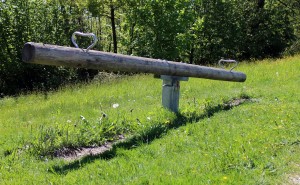
Growing up, if there was anything my mom preached, it was balance. She stressed everything in moderation. Sugary treats and other junk food were fine – in moderation. Relaxing in front of the TV (aka being a couch potato) – yep, fine, in moderation. As we got older we were told that alcohol, too, is fine – in moderation.
As I got older, I realized that work and play also need a balance. Too much of either is really not good for you. Having balance in your life is a positive – we strive to have balanced meals, balanced accounts. Unbalanced people frighten us. When things don’t quite feel right, we may say we are “off-balance.” Losing one’s balance is a cause for alarm, whether standing someplace high up or merely experiencing vertigo.

Merriam-Webster defines balance: to bring into harmony, mental and emotional steadiness, an aesthetically pleasing integration of elements. Synonyms include: stability, equal opportunity, fairness, and steadiness.

Balance is a good thing. However, in this busy, crazy world we live in, it is often difficult to achieve. Parents struggle with balancing their lives to meet the competing needs of their children – time spent with them and money to pay for their basic needs (and some wants). In families with more than one child, that struggle for balance is more complicated. Employees struggle with doing their job well to please their bosses (and further their careers) and having a fulfilling life of their own outside the workplace.

I never thought it about it before, but I guess that I internalized the idea of balance long ago. When I made the decision to abandon my plans to go to vet school, I did so because I knew this was an area I would find too difficult to balance. Some careers work well with a family, and some women may be able to make this one work, but it was not right for me. Though I still have a fascination for medicine (and get pumped up about new advances while reading the Health section of the Sunday newspaper), I think I made the right choice. Though I have gotten frustrated with myself for not accomplishing more some weeks, I have the flexibility to schedule my tasks around whatever life throws at me. No one’s life is dependent on my work, and I don’t have to make the choice between my job and my family, I can have both.

Though I have long understood the importance of balance, I have not mastered it. Oftentimes, things creep up on me and I find that nothing is “right.” When I stop to look at things, I usually realize that I have allowed some things to take precedence and other things have been let slide. Most of the time, I am finding that it is simple things that are lacking, that have sent me off-balance. It may be that I realize it has been days since I have been out of doors, or that I have spent too much time on “must-dos” and not enough on fun stuff. Perhaps I have spent too much time pondering life, or not enough time making plans. Lately I have gotten better at accomplishing tasks, and have even been able to find a way to prepare more balanced meals. Part of this is better organization, and more planning. Based on prior history, it is something that will not last without a conscious effort.

I have a conflicted attitude about planning. On the one hand, I find planning to be restrictive and confining, lacking spontaneity. On the other, I find it calming and reassuring, knowing that I have a blueprint makes the difficult look less so. Schedules and lists help keep me on task; the key is to schedule free time in as well. I know I am not alone in this, but often having many things to do means I get many things done, while having just a few often means I accomplish less, even though my “to do” list is never done.

I came across this quote, which was attributed to Albert Einstein in a letter to his son. “Life is like riding a bicycle. To keep your balance, you must keep moving.” This actually makes a good deal of sense to me, with a qualification: in moderation. I am a big fan of downtime, and have frequently imposed it on my ever-active children, but recognize that it, too needs to have an end, a time when the recharging is complete and it is time to move again.


Beginnings … and Endings

Almost two weeks ago marked my last first day of school. My youngest is now a high school senior. Last week, I went to my last Back to School Night. Over the past 21 years, I have been to 46 Back to School Nights. There have been many changes in that time, in my life, in the schools, in the world.

When my first child entered school, I was clueless. I had no idea what to expect. Up until that time, I knew few people in town and felt somewhat isolated. I was pretty quick to get involved and found many ways to help out, both in and out of the classroom. I made friends with my kids’ friends. We found out about community organizations. Flyers came home with enticing activities to sign the kids up for. We signed our kids up for T-ball and therefore became coaches. Soccer and basketball followed (different sport, same drill – coaches are always needed). There was a brief trial of cheerleading and years of dance and scouting. Middle and high school years added choir, marching band and a plethora of clubs. We bought a van.

Our first classrooms had computers – new computers. Each classroom had its own. Many kids today would not recognize them as computers. They were a combination of boxes and a keyboard. In upper levels, they used them for projects and saved work to a disk. Today, most middle and high school students have school issued computers that fit in their backpacks. If they need to transfer info from one to another, they use a thumb drive. In those early years, some projects required the students to write notes on transparent sheets to be projected onto the white- (or in some cases chalk-) board. Today, they plug in their laptops to the Smartboard and go.

Paper directories were printed with each student’s address and phone number so they could reach each other outside of school. Now, the directories are online, though students more often contact each other through Facebook, Twitter or text. On a similar note, every home had a phone, which was used to contact any person in the house. Today having a landline is unusual and each family member has their own number.

The media also has changed drastically. Cable had about 60 channels, now there are hundreds. You no longer have to tune in to a certain channel at a certain time: even TV is “on demand.” Years ago, most people got their news in the morning or at noon, 6:00 and 11:00. Now, they turn on their computers or look on their phones. Some papers and magazines from 1993 no longer exist; most if not all “print” media are now available in digital format. Music was purchased on CDs, the cassette tape on its steady way out. Now most people listen on iPods.

Life has been the same, but different. Through all of this, I have been able to be home to help my kids with homework and listen and sometimes help them navigate the world. I have been involved in the schools and their other activities and have made even more friends. In a way, I grew up with my kids. 21 years ago, I really didn’t know who I was (honestly, I am still figuring this out). I had NO idea what challenges were ahead of me. I didn’t even know enough to worry about surviving the teenage years or dealing with the emotional balance involved with parenting adult children.

In hindsight, I am happy about this. It means I was living in the moment. Certainly not appreciating the moments as much as I wish I had, but very much living them. A year from now, much of this will stop. I will still have my friends (many of whom have some years before their journey through the schools is over), but the activity level will cease, abruptly. I will still go to the performances, but will no longer be active behind the scenes. I expect that it will all be very strange.

This past summer has been a constant surge of activity and I have just been riding the wave of activity that goes along with moving one child into college and looking for a college that best fits the needs of another. I have been torn. I look forward to a break in the activity, yet do not look forward to the long stretches of quiet that will come way too soon. Fortunately, my kids have made sure that my schedule will not allow me time to dwell on that.

It has been a year since I first wrote here and I am happy to say that I have met one goal: I am writing more often. Although I am frustrated with myself that I have not written more, I really don’t have regrets. I have very little time left to just be Mom and I don’t want to miss anything. I do however have a new goal: I want to plan more.

We are now two weeks into the school year so it is time for me to get more disciplined. I am almost used to the schedule again (why can’t the day start after 8 a.m.?) and have a calendar full of events. I have a project (or two or 10) to finish and want to start posting here regularly (maybe once a week). Calendars and lists tend to be my friend in times like these. My biggest challenge lately is the pop-up issue that inevitably takes up more time than should be necessary. (This is often due to recorded messages and cumbersome menus to get to real people – why do I have to push anything? Just answer the phone!) Maybe the answer is to schedule them as well. If nothing pops up, well, more time for me!


Related posts:

Soccer Mom No More


Live Like You Were Dying

I recently had the good fortune to attend a Tim McGraw concert with my oldest daughter (thanks to my niece who was unable to use her ticket). It was a very enjoyable night. The weather was all one could ask of a pre-summer evening (as it was pointed out to me, it was not yet summer); we sat and danced on the lawn outside the amphitheater that housed the musicians and the more expensive seats (though we could not see as much, I think our location was better than most under cover as we had a bit of a breeze). The music was good and I got to spend some rare one-on-one time with my daughter.

McGraw closed the night with his signature “Live Like You Were Dying.” In this song, he tells of meeting a man who was faced with a serious disease and the epiphany he wanted to share. He says “I went skydiving,” (go ahead, sing along) “I went Rocky Mountain climbing, I went two point seven seconds on a bull named Fu Man Chu…”
These are true “bucket list” items, and it is common to put them off for “someday.” Unfortunately, for many someday doesn’t come until you are faced with a true life crisis like a life-threatening illness. I think the real meat of the song however, deals with personal relationships. The song continues, “I loved deeper and I spoke sweeter, and I gave forgiveness I’d been denying. And he said, someday I hope you get the chance, to live like you were dying.”

Too often in today’s world, we get wrapped up in ourselves and our “things” and neglect what is really important, those we love and who love us. Things are said that hurt, things are misinterpreted (especially in our high-tech society where there is little face-to-face interaction), words are exchanged in anger or frustration that do not fully express our thoughts, feelings, intentions.

Anger is not an acceptable emotion in our society. There doesn’t seem to be a “nice” way to tell people that you don’t like something or that certain things are objectionable. Voicing displeasure frequently results in a reaction, a sort of “How dare you say that!” This can then escalate quickly with both parties saying things they didn’t intend to and quite honestly, that are not even relevant to the current situation. Few people are able to sit quietly, listen to grievances and ponder whether there may be any merit to them. Perhaps that stems in part from our belief that we have the “freedom” to do and say whatever we want (however, I don’t believe that is what our founding fathers intended in declaring we have freedom of speech).

I came to the realization a couple years ago that the truly loving makes one completely vulnerable. If we do not love, others have no power to hurt us. In my life, I have been most hurt by those whom I love the most. Knowing this, would I have chosen to not love? Of course not. The good greatly outweighs the bad. This realization has given me a different outlook, however, one in which I somehow find it easier to forgive.

The flip side is that we also have the power to create the greatest wounds in those who love us. This is something we really don’t want to hear. Realizing you have hurt your loved ones is a very different, but equally devastating, kind of pain. Sometimes this is unintentional, sometimes it is reactionary (they did something unacceptable, so we have to get even). Sometimes, the perception of an issue is lopsided – one may be more vested in the disagreement than the other while the other may not know the extent of the issue (truly stepping in another’s shoes is very difficult, even when we try). Sometimes a short cooling off period makes things better and things can be talked through (or not; some things are better left unsaid). Other times, a simple apology clears the air. Sometimes, parties need to agree to disagree. In some cases, communication ceases and it seems like the relationship is doomed. This is the kind of rift mentioned in the song, where one (or both) parties withhold forgiveness.

Having experienced such rifts, I can say that they are really not worth it. Being “right” can sometimes be miserable. Not being able to share special and everyday moments with someone who just “gets you” is lonely. Getting older makes one realize how precious life is and how much value is added having wonderful people share it with you. Too many have been taken from us too soon. Personally, I want people in my corner, even if they do not always agree with me. When they have the courage to tell me, I know that they care (even when I don’t like what they are saying). I don’t put conditions on relationships, nor do I insist on apologies. There are a number of people I want in my life, and I accept them as they are (after all, why would I want them around if they need to change?)

I am not saying that it is okay to treat people badly or that one should say it is okay that someone has spoken ill of or to you. Some wounds take time to heal. No matter how hard we try, words cannot be taken back. However, it is often the case that both parties share some level of blame. Maybe there is some kernel of truth in what was said, something you don’t want to hear or admit about yourself. Take a look at yourself; can you really cast the first stone? Maybe what was said or done is not really as horrible as you first thought and you have overreacted a bit. Maybe words were exchanged and things kept getting worse, even if you meant to make them better. Maybe more time and reflection is needed to put things in perspective. Going back to the song, the man “became a friend a friend would like to have,” and then “took a good long hard look, at what I’d do If I could do it all again.”

There are some decisions that everyone has to make for themselves. We all make mistakes (I have a rather hot Italian temper that gets me in trouble sometimes). Consider what you want from life. Who do you want in it? How do you want to be remembered?

These words speak to me: Speak sweetly. Give forgiveness. (Perhaps more importantly, accept it when it is offered to you, without excuses, conditions or reservations.) We are only on this earth for a short time … Live like you are dying.


Time Travel

The past few months have been a whirlwind and I honestly can say that I am amazed that it is June. Though I would like to have a handy dandy box to climb into and go to any time I want (or just make it stop for a little while), my reference to time travel is really about something different. I am referring to the ability to transcend time and place immersed in a good book.

One of my favorite genres is historical fiction. The past few summers, I have indulged in traveling back to the 1400s, to the court of King Henry and his daughter, Queen Elizabeth and their contemporaries. I am fascinated by the many characters living in this time period. I am also interested in writing historical fiction, but think that this era already has enough (I have 3 or 4 books ready for this summer as well, and have still just scratched the surface of what is available).

Instead, I am currently immersed in a time just a little over 100 years ago, doing research that covers a span of just days – the maiden voyage of the ship Titanic. I have long been percolating a book about the story and have decided that now is the time to complete it (or at least enough of it to send it off to try to find a publisher while I keep working on it).

I have a few other ideas for historical fiction, but this is the one I am currently most passionate about and have the most research complete for, so this is the direction I will take. Unfortunately, other ideas keep popping up, so I have to take some quick notes and file them away for later. My other delay is that life has a way of getting in the way. Fortunately, I knew that May was going to be a busy month and reduced my expectations (though I have been able to immerse myself in 1912 sitting in waiting rooms and in the car waiting for my daughter). Questions and answers are coming unbidden into my mind, and I have changed direction a few times, but I think I am just about at a place where I can sit and write and have it all pour out (with some interruptions for new questions, then research to find answers, etc). With the school year coming to a close, I think I will have some time in the coming month to lose myself (or lock myself in the study) and become immersed in the writing process.

I think I am going to have to get tough and set some rules though. The internet and phones are very real distractions. I don’t think I need to go cold turkey, but think I can limit access to certain times each day (while still being available to my family). There is also the very real problem that everyone needs to eat. (This is a problem, because when I get started, I don’t always think about food – hmmm, this may be good for my waistline.) I haven’t figured that one out yet. The crock pot will work some days, but I don’t know about a couple weeks worth of crock pot meals. The problem: I hate schedules and routines and the muse doesn’t always appear on schedule. The reality: I actually work pretty well with schedules and LOVE lists (especially the crossing out part). I guess I’ve got the first step accomplished – I’ve figured out what I need to do. Now it’s time to find a way to implement it.


Speaking for Others

Last month I had the privilege to accept an award for my uncle, someone who has been very influential in the world of children’s literature and has changed the face of children’s poetry. Not only has he entered the Guinness Book of World Records for having the most published poetry anthologies, he also has encouraged and mentored aspiring poets, has sponsored writers’ workshops, given speeches to groups of teachers, librarians and students, and has many other books to his name (this is just a smattering of his accomplishments).

So, being asked to accept this award was something special for me. Although I know that he has accomplished all this, I really just think of him as my uncle. When I was young, besides seeing him for holidays, I spent a week with him most summers and we did fun stuff – theater, amusement parks, wandered his garden, and browsed his library.

I first heard him speak at an event for librarians in Somerville, New Jersey when I was in high school. I noted that he was a very good and engaging speaker. Although I grew up reading his books, interspersed with those of other wonderful writers, I had never thought about the process that took place before those treasures entered my hands.

I believe the next time I heard him was at my local elementary school, where he mesmerized the entire student body before engaging smaller groups of the older students, inspiring one class to write a poem in his honor. This was exciting because I was involved with the planning and got to spend a couple days with him in my town. More recently, I had the opportunity to see another side when he was presented several years ago with The NCTE Award for Excellence in Poetry for Children in Philadelphia. I was fortunate to celebrate with him that day and enjoyed listening to a parade of fellow writers talk about how he helped them, both professionally and personally. This was the first time I realized how profound and widespread his influence in today’s world of children’s poetry really is. (It was also when I discovered that “Dear One,” which he used to start his correspondence with me, was the salutation he used for many close friends and family members.)

I had a couple months to prepare myself to accept the award and honestly, I was very comfortable with the idea. I have gotten up in front of people before. I have written a speech or two. I wouldn’t know anyone there. The entire event had nothing to do with me. By the week of the event, I had a rough draft complete. The night before I was to leave, the muse awoke in the middle of the night with better ideas than were on paper, so I went downstairs and complied, getting the text in the computer, knowing I had hours to polish it the next day before leaving. I took care of these details with hours to spare, hit print, and panic set in. Why? I still can’t answer that question.

Off we went to Hershey. The nerves continued. The next morning, I tweaked a bit more, deleting a couple paragraphs (which have reappeared here) and it was time. We got to breakfast, where I picked at my meal (If you know me, you know that is really weird) and then it was time. I got up and accepted the award, with legs like jelly. Kind words followed, but I know I could have done better (after all, I know I can pronounce all the words I had written, there was no excuse for stumbling over them). I have never liked hearing recordings of myself. Maybe that is somewhat behind my reluctance to watch the video (taken at my request so my uncle could see it).

The experience was overall a good one, and I am happy that I was able to be there for my uncle. I also attended one of the workshops that morning, which was good for me personally, as it was given by the two authors who had also been presented “Readers Choice” awards that day by some of the students who had voted to select their books. These authors were engaging and inspirational, as well as very personable and generous with their time and advice. A month out, I am still holding onto the motivation to get my own book complete and out there. Maybe, with a little luck, there will be some of my own speech writing to do in the future.


Partnerships

Earlier this year, a story hit the news about a major league baseball player taking time off to be at his child’s birth that had me dumbfounded. Certain individuals were critical of his choice, saying that baseball needed him more than his wife and new son did. In a follow up story this week (focusing on how fatherhood has changed in recent decades), I saw that it was, thankfully, limited to a certain few vocal commentators and that his teammates were supportive of his choice. I think it is noteworthy to mention that this man was in fact completely unaware of all the brouhaha until days after the fact. He was in the family zone, away from external pressure and judgment, in a place where nothing matters but your loved ones.

We need our loved ones to be with us for big events. We may not physically need them there, but we need the love and support that sometimes only they can provide. Childbirth is most definitely one of these times, especially for a first child. You can take all the childbirth preparation classes available, you can talk to every other mother on the planet; you can repeatedly be reminded that women have been doing this since the beginning of time, but you will never, ever be fully prepared for the experience. I remember my first child’s birth. I remember the helpless feeling and I even said that I was not sure I could do it. My husband being there, encouraging me, helped me to believe and I am certain made it easier for me, and consequently, better for the baby.

To have public figures get up and say that he should have been there for the birth and then gone straight to the game, or even worse, say that she should have scheduled a C-section before the season began is wrong. I can’t find words strong enough to state my case here. (I have had a scheduled C-section, and that is not something to opt for without just cause.)

Thankfully, general opinion is on the side of the new dad. Many factors are I am sure at work here. I hope that the strongest is that it is becoming recognized that this is a big event for dad as well. For too many years, pregnancy and childbirth was treated as a medical disability (the way most companies justified time off for mom). More companies are giving paternity leave, though I was surprised at the very low statistic offered on the morning news (12%). This has been offset by many new dads taking vacation or unpaid leave (to the tune of 85% of new fathers). Yeah dads!

Studies repeatedly show the importance of dads in children’s lives. The dads of today want to do more and have forged ahead and taken on new roles unimaginable to fathers just a generation or two ago. Why do these stereotypes continue? Perhaps the backlash on stories such as these is a sign of a change in public thinking. Or maybe this is just a “glass half full” sort of thinking.


Happily Ever After

Twenty six years ago today, I married my high school sweetheart. At the time, we were young and idealistic. We were fearless, confident, cocky even. Over the years, we have (mostly) raised 4 children, 3 dogs, a cat and countless smaller pets, switched jobs and moved frequently. We bought a house, demolished and rebuilt half of it and are still working on improvements to it, large and small.

We have known each other for most of our lives. Having met as kids, our experience is different from many married couples we know. We share much more history than most. We have no secrets of prior lives. We know just about everything there is to know about each other.

Even so, we have changed. We are not the same people we were then. We have been shaped by our experiences and our reactions to them. We have shared highs and lows, joys and sorrows. But after 30 years together, we still sometimes manage to surprise each other.

How have we done it? Many marriages today don’t make it half this far. The simple answer is that there is no other option. We made a promise and fully plan to honor it. (Maybe that’s what happens when you combine people of Polish and Italian heritage – can you say stubborn?) Has it always been easy? No. Have we always been blissfully happy? No. We are both passionate people, which means we love passionately, we fight passionately. We agree passionately and disagree passionately. We are a lot alike and nothing alike. In some ways, I think we complete each other. Our wedding song, Billy Joel’s You’re My Home, sums things up nicely for us.

Life has sometimes gotten in our way. The busy-ness of kids and household chores, work and extended family has sometimes taken the focus off of each other. We used to have regular weekends away, just the two of us. For a number of reasons, those weekends slipped away over the years, but recently we have been able to carve out some time and we talk about doing it more. Life still has demands, but I think we are starting to get better at countering them with demands of our own.

The idealism has waned. I know the world isn’t perfect and life is not easy (or fair). Marriage is hard work, but like anything else wonderful in life, it is worth putting forth the effort. I’m not going to lie: we have had some tough times, but we never stopped loving each other. Maybe love does conquer all. Despite, or perhaps because of, all the challenges we have faced, I remain confident that my future includes happily ever after, with the wonderful man I have loved for most of my life. Together we can accomplish anything!


Grandma’s Treasures


Note:    I wrote this piece 16 years ago, in 1997. Grandma passed away in September 2002. Her birthday was this week, and while working on something else,  I was reminded of this piece.  (I haven’t looked at it for years.) It didn’t seem right to edit it to bring the story up to date, so I have left it as it was.

“Go through the house and tell me what you want,” my mother said.  “The rest is going to the Salvation Army.”

We were cleaning out Grandma’s house.  She had some expensive items, such as stained glass lamps and craft show items given to her as gifts, and some antiques that were my grandfather’s (her late third husband, whom I was blessed to know for almost 20 years).  These were nice to have, but these really weren’t Grandma’s.  She was the “Woolworth’s Queen.”  Grandma was never rich, but always spent her money freely on us.  Stuff for herself usually came from Woolworth’s Department store, or more recently, the Dollar Store or Wal-Mart.  Every other store was too expensive.  Grandma was a collector – she collected unique salt and pepper shakers and everyday things like dish towels and throw rugs.  She seemed to never have enough.  Perhaps this was a result of being the oldest child of five during the depression and growing up poor, and then struggling to raise three as a single mother in the fifties.

She was a collector, but also gave many things away.  She always had time for a “Hard Luck Harry” and would open her home and wallet.  Trick-or-treaters got timestakingly-assembled bags of candy, and when she ran out, rolls of coins.  Every Christmas season, she would unpack her boxes of decorations and offer me Christmas dishtowels, of which I would end up with two or three.  Every year she bought more.  This was her biggest decorating season, although her house was decorated all year.  Christmas was replaced with Valentine’s Day, then St. Patrick’s Day, Easter, Memorial Day, Fourth of July, Labor Day, Halloween, Thanksgiving, then back to Christmas. When meeting someone from her old town, all you had to say is the house with the decorations and they knew exactly where she had lived.  She offered tours at Christmas, and usually sent guests off with a souvenir. Children certainly went home with candy, money or both.

Sorting through her stuff was strange. The vast quantities were overwhelming, and the “good stuff” was randomly interspersed with dollar store items.  I’m sure we let some treasures go during one of the many yard sales, or one of the many visits to the Salvation Army store.  This final trip through the house was by far the most difficult. You see, Grandma is still with us, at least physically.  Alzheimer’s has robbed her, and us, of her life.  After she was diagnosed, she moved in with my parents, who shortly thereafter moved to Florida. Now, the house was sold, and Mom and I spent several painful hours in the attic sorting through Grandma’s prized Christmas decorations.

Your typical decorations were there, cardboard cut-outs, lights, garland, plastic lawn figures, some in good condition, others ripped and broken, which we threw out. Then there were the special things – my grandfather’s Christmas stocking with his name hand-embroidered, Grandma’s apron, some borderline-tacky decorations I remembered from my childhood.  These things gave us pause, and my mother kept saying, “She would never let us do this if she weren’t sick.”

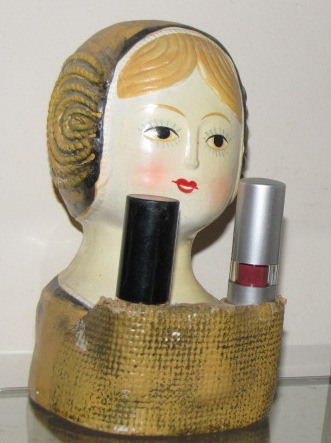
After I packed the car, Mom told me to take another walk through the house to see if there was anything else I wanted. I went home in tears, thinking about what has happened to Grandma and also about how this would likely be the last time I would see her.  She wasn’t eating and Florida was so far from Pennsylvania.  During the ride home, I realized there were a couple more items I wanted.  I knew Mom (and my husband when he saw it) would likely think me nuts, but one of these was a lady’s head – a lipstick holder – that Grandma had kept in the bathroom for as long as I could remember.  Certainly not something I would call attractive or even useful. The other was a set of three glass perfume decanters she had always kept on her dresser (I thought these would be nice for my three daughters to have down the road).

I arrived home and again started to cry.  Almost every room in my house has something that belonged to Grandma – furniture, lamps or some little knickknack.  She had always given me things, weeding out her possessions, making room for more, but the items in my car she would never have parted with — even if I had asked.

This experience has caused my mom to streamline even more than usual.  When they moved south, she got rid of many things she had been holding onto for merely sentimental reasons. This cut down on moving expenses, but was done mostly to spare my sister and I from having to clean out her house and make difficult decisions about what to do with everything.  Mom says I’ve got the “pack rat gene.”  I prefer to think of it as preserving history. I have at least one child who shares my love of old things, valuable or not, and she is the one who continually prompts my forays into family history with new questions. Unlike many of my elusive ancestors, an anthropologist would have no problem reconstructing my life.

I have been fortunate to see Grandma a few times since the move three years ago. She is now living in a nursing home, the disease having progressed too far for my parents to care for her themselves. Though she doesn’t always know who I am, I enjoy my visits and treasure them as I do the constant reminders of her love around my home. Thanks, Grandma, for everything — especially that pack rat gene.