How Grandparents Can Help: Promote Good Sleep Habits
Things change. Every generation complains about it, but parenting looks a little different each generation. This is in part due to new advances, in technology and medicine, but also to changes in society. Today’s parents grew up in a world very different from that of their parents, which was even more different from that of their grandparents. One could argue that the changes over the past 20 years have marked the most dramatic shift of all. While the world my grandmother inhabited as a child sounds quaint to me, my children can barely relate to my childhood, and it will likely be incomprehensible to my grandchildren when they hit the teen years.
As much as things change, many things will always be the same. One of these is that new parents spend a great deal of time obsessing about sleep. Babies spend most of their early months sleeping, but their parents don’t. It isn’t as easy as people think for new parents to “sleep when the baby sleeps.” It’s a nearly universal truth that parents of young children don’t get enough sleep. And the research is clear, insufficient sleep can lead to a number of health issues, both physical and mental. According to a Wisconsin Sleep Cohort study, for every child under the age of 2, parents get 13 fewer minutes of sleep each day. And as children age, the sleep deficit barely moves. (The study estimates parents get 9 fewer minutes of sleep per child aged 2 to 5, and 4 fewer sleep minutes for children age 6 to 18.) Over the course of a childhood (which is multiplied when you have more than one), that is a serious sleep deficit.
New book offers help to sleep deprived parents
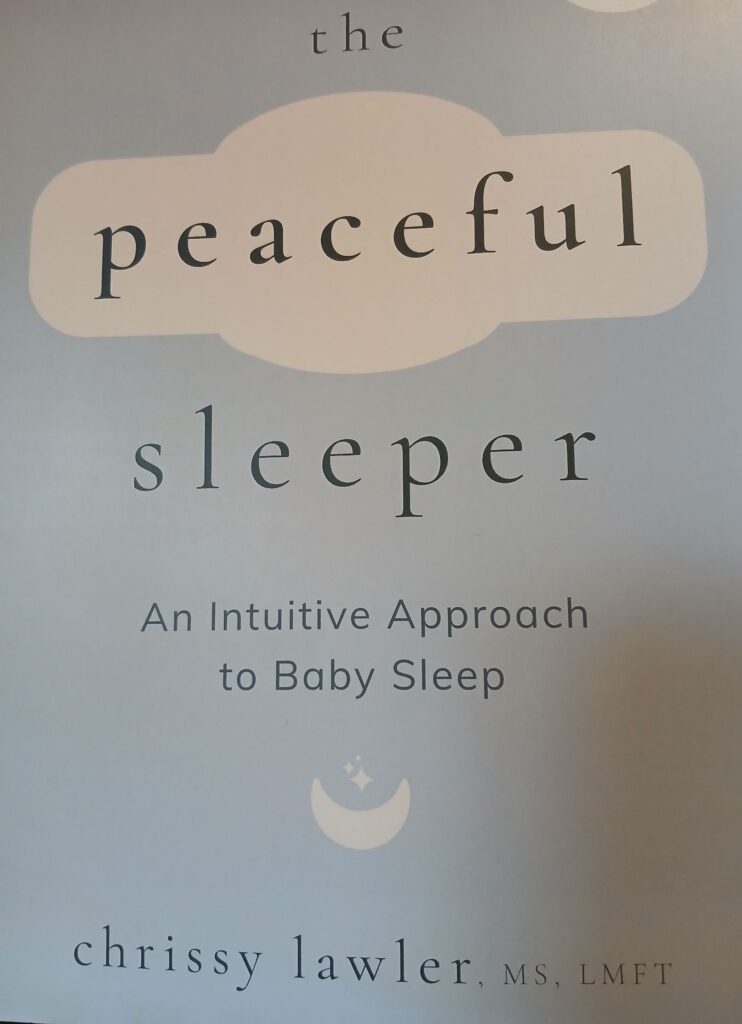
Chrissy Lawler, MS, LMFT offers some relief with her new book, The Peaceful Sleeper, An Intuitive Approach to Baby Sleep, an easy-to-digest guide to help your baby sleep. Lawler explores the science behind sleep patterns and explains why sleep is so important, for all of us. She offers a step-by-step method to help babies work toward independent sleep that parents will find both manageable and flexible.
While demographically, you wouldn’t expect me to be a target reader, I enjoyed this book. Yes, it validates many things I have done myself, but I also learned some new tips I look forward to sharing with my kids and using myself when Grandma-duty coincides with bedtime. Lawler uses her experience as a family therapist to explain why it is important to sleep train babies: quite simply, it is good for them, and also for the rest of their families. She shares her methods as a successful sleep coach while stressing that parents can and should adapt her program to meet their personal needs. She empowers parents, pointing out that all babies are different, even in the same family, and that these are not hard and fast “rules.”
As a grandparent, I’m occasionally consulted about parenting challenges and the bedtime routine sometimes is left to me. I remember those early days with babies (somehow the sleep deprivation memories haven’t faded as much as those associated with the actual birthing of said babies), and, from the start, I made a conscious effort to spend as much time as I could helping the new parents get some sleep, during what I (originally jokingly) referred to as my grandmaternity leave.
Grandparents aren’t too old to learn new tricks
During the early days home with a newborn, new parents are typically overwhelmed, and don’t know what they don’t know. If they are also running without sleep, it is even more important to offer guidance and support. I am realizing that keeping up with new childraising methods and research is not only helpful, but important as a grandparent. Like my mother and grandmother (and likely the generations before), some parenting choices may not make immediate sense to me, but they don’t have to. I’m learning that if I keep an open mind, and learn the “whys” behind recommendations, I may understand, and if nothing else, be better able to communicate how and why I feel about “the way things are done today.”
I believe it’s important to keep an open mind and to always be learning. I’m also realizing that being a grandparent means more than playing with grandkids and supporting their parents. It also means keeping up with trends, and perhaps even learning about and sharing research that overwhelmed parents simply don’t have the time or energy to seek out. I never expected to be reading books that address the early stages of parenting at my current age and stage, but think it’s likely that many more will be added to my TBR list.
Note: Though an advance reader copy of this book was provided free of charge, no compensation was made for this review and the opinions are exclusively mine. KY